An era is opening in which, beyond communication between people, and between people and things, things themselves converse with each other over the internet. A time is near when all the appliances and lighting and control devices in the home, along with wearables such as smartphones, glasses, and watches, and everything on the streets—cars, streetlamps, buildings—will be connected to the internet and exchange information with one another.
Things connected through the internet will create new value through vast amounts of big data. Human life can become richer, and corporate economic activity can also be carried out more cost-efficiently. To this end, <Digital Daily> has prepared a feature to survey the future of the Internet of Things (IoT) and forecast the effects it will have. <Editor's Note>
- [Event Notice] [Digital Daily Innovation Forum 2014] Internet of Things (IoT): Challenges and Opportunities
[Digital Daily, Reporter Lee Soo-hwan] The home appliance sector this year is set for competition fiercer than ever. Samsung Electronics and LG Electronics have rolled up their sleeves aiming for global number one by 2015, while overseas players like Electrolux, Miele, and Siemens are accelerating their push into the Korean market.
The home appliance market grows slowly, but once you build it up, it can serve as a long-term cash cow, which makes it attractive. You can expect returns in both developed and emerging markets, but in many regions there are local players deeply entrenched, and building out distribution requires significant effort. Customized, region-specific strategies are therefore essential.
Where IoT-enabled appliances will see commercialization first remains uncertain. Without a killer service, success is hard to guarantee even in developed markets where premium lineups have been built. However, the industry expects mass adoption within the next 3 to 5 years.
For emerging markets, active convergence with the smart grid can be considered. IoT appliances have high utility in regions where electricity supply is unstable. A representative example would be applications that schedule refrigerators or washing machines to run outside peak power shortage hours.
◆TV is the core of smart appliances=So far, the product regarded as most advanced in IoT appliances is the smart TV. It has been rolled out steadily since 2010, and Samsung Electronics and LG Electronics, first and second in the market, are both aggressive. Other TV makers also treat IoT environments built on smart TV as a given. The issue is that each player's ecosystem differs, making synergy hard to achieve.
Samsung Electronics uses its own Linux-based OS and Tizen, while LG Electronics leads with webOS. Other than these, Android is generally the norm. To secure connectivity with white goods like refrigerators and washing machines, an expansion policy for OSes is essential.
According to market research firm Strategy Analytics (SA), a total of 76 million smart TVs were shipped in the 2013 flat-panel TV market. That is a 55% increase year-over-year and a 33% share of the total market. This means smart TV, like 3D, is becoming a standard feature rather than an option.
◆Home appliances also riding the IoT wave via smart=While smart TVs are expanding quickly, smart appliances centered on white goods will likely need significant time to take off. Refrigerators with smart features have been around for a long time, but adoption remains minimal. As a result, IoT connectivity with smart TVs, smartphones, and tablets has in practice been quite difficult.
Samsung Electronics is betting on 'Samsung Smart Home' to address this. By tying together home appliances, smart TVs, smartphones, tablets, and even the Galaxy Gear wearable via a unified platform and dedicated server, a single integrated app will let you control and manage every device in the home.
On top of this, Samsung plans to develop a Smart Home Protocol (SHP) to interconnect devices in the home and apply it to all Samsung smart home target products, extending it to other companies' products as well to energize the smart home ecosystem. They even set out an ambitious strategy to expand into various areas such as smart access control, energy, health, and eco-friendly services.
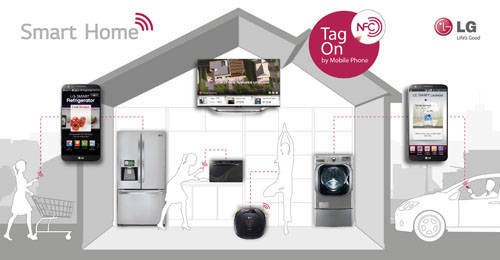 |
LG Electronics is taking a 'ready' approach, one that sufficiently prepares for the smart appliance era rather than pushing smart appliances right now. First, using the messenger service 'LINE,' they offer 'HomeChat' for remote control, monitoring, and content sharing. HomeChat is being sequentially applied to smart appliances like refrigerators, washing machines, ovens, and Roboking. Building on this, the plan is to construct an IoT ecosystem.
On top of that, LG plans to allow additional communication modules for IoT connection—Wi-Fi, Bluetooth, Zigbee, and others—to be fitted to previously sold products.
<Reporter Lee Soo-hwan> shulee@ddaily.co.kr
